Food and powder dust collectors
Food powders are valuable, and many are combustible. A collector for food and feed plants has to recover product, stay clean and be designed for dust explosion risk.
Combustible dust
Sugar, flour, maize, soya, starch and many other food powders can explode when a fine cloud meets an ignition source. A dust collector is one of the places where that cloud exists, so it must be designed for it.
- Anti-static filter bags with conductive fibres, earthed to the housing, so static charge cannot build up.
- Explosion panels that vent safely to a safe area if an explosion happens.
- Rotary valves that discharge dust while helping to isolate the collector from the process.
- Earthing and bonding of the housing, cages and ducting.
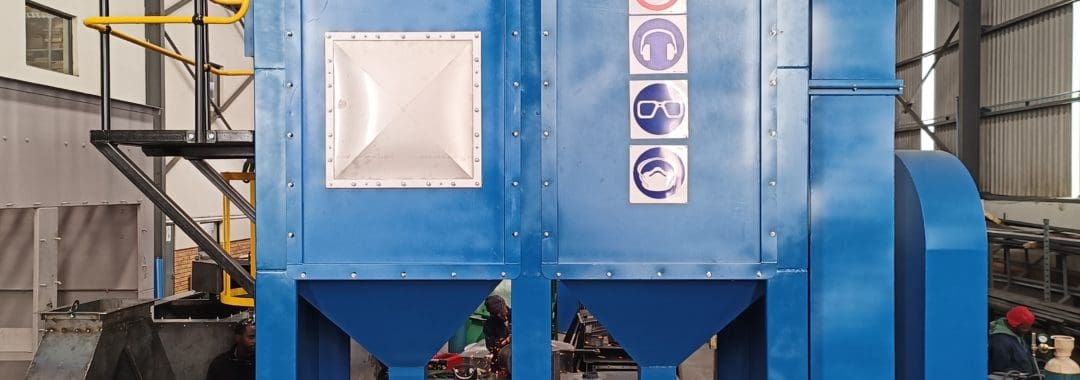
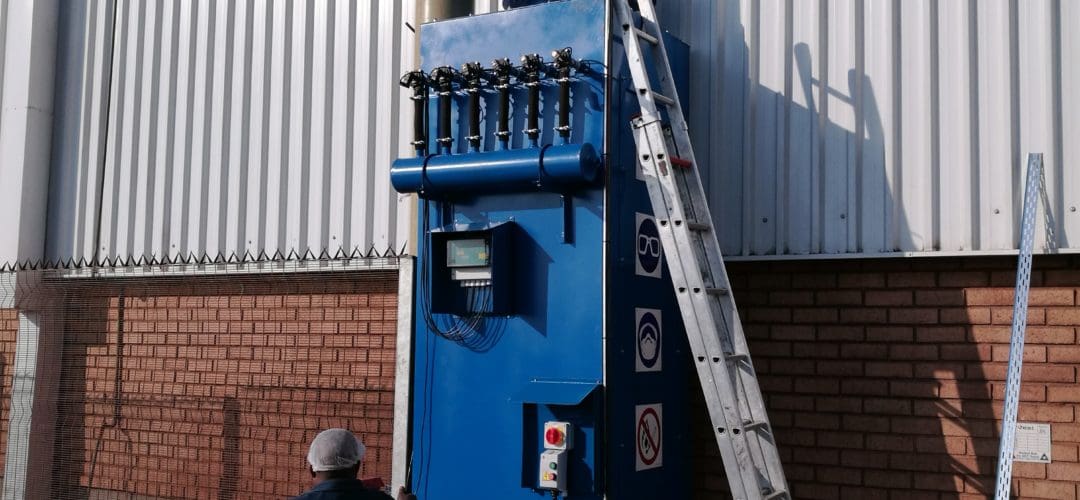
Our dust collector for a sugar plant in Zambia used anti-static membrane coated bags, an explosion panel, a fan and two driven rotary valves.
Recovering product
Much of what a food plant's collector catches is good product. With the right discharge, such as a rotary valve, screw conveyor or bag-off point, it can often go straight back into the process.
Hygiene and corrosion
For food contact, washdown or corrosive conditions we build collectors in stainless steel, with smooth internal surfaces and hoppers that discharge fully.
Powders we handle
Sugar, flour, maize, soya, starch, milk powder, spices, animal feed, premixes and other dry ingredients.
FAQ
Do you build in stainless steel?
Yes. We have built all-stainless collectors for corrosive environments and for food plants.
Can the dust go back into the product?
Often, yes. If the captured powder is clean product, we design the discharge to return it to the process.
What size collector does a soya plant need?
It depends on the process. One soya plant in Mpumalanga needed 164 m² of filter area with a screw conveyor and rotary valve. We size each plant on its own airflows.
Send us your dust problem
Tell us what you are extracting, roughly how much air, and where the unit will stand. We will come back with a sizing and a quote. A site visit is free in Gauteng.