Baghouse dust collectors
Our most common collector. Many cylindrical filter bags give a large filter area in one housing, and short pulses of compressed air keep them clean while the plant runs.
How a pulse-jet baghouse works
Dusty air enters the collector, usually at the hopper. Heavier particles drop out straight away. The air then passes through the filter bags from the outside in, and the dust stays on the outside of the bag. Clean air rises inside each bag, through the tube sheet and out of the clean-air outlet.
As dust builds up on the bags, a sequencer opens diaphragm valves one row at a time. Each valve releases a short, sharp pulse of compressed air down a blowpipe into the bags. The shock wave flexes the bag and knocks the dust cake off into the hopper. Only one row cleans at a time, so the collector never stops filtering.
Read the full guide: how a baghouse works
Why plants choose a baghouse
- Over 99% air cleanliness, so the stack runs clear.
- Large filter area for heavy dust loads and continuous, 24-hour duty.
- Media options for high temperature, high moisture and non-stick duties.
- A simple bag and cage layout that keeps maintenance costs down.
- Robust welded steel construction, built for South African site conditions.
Typical specification
| Airflow | 1–36 m³/s standard |
| Cleaning | Pulse jet, microprocessor sequencer |
| Filter media | German media, chosen per duty |
| Bag access | Top-access or walk-in plenum |
| Dust discharge | Rotary valve, screw, bin or bag-off |
| Build | Mild or stainless steel, indoor or outdoor |
Matching the bag to the dust
The bag material decides how hot the gas can be, how well the dust releases, and how long the bags last. These are typical limits; we confirm the choice against your process.
| Media | Typical max. continuous temperature | Where we use it |
|---|---|---|
| Polyester felt | about 130 °C | General dust, blasting, woodworking, mining |
| Polyester with PTFE membrane | about 130 °C | Very fine dust and tighter emission limits |
| Anti-static polyester | about 130 °C | Combustible dust such as flour, sugar and wood |
| Acrylic | about 125 °C | Damp gas and mild acid conditions |
| PPS | about 190 °C | Boilers and coal-fired processes |
| Aramid | about 200 °C | Furnaces, asphalt and hot process gas |
| PTFE or fibreglass | about 250 °C | The hottest and most chemically aggressive duties |
Need replacement bags for an existing unit? See filter bags and spares.
Built in our workshop
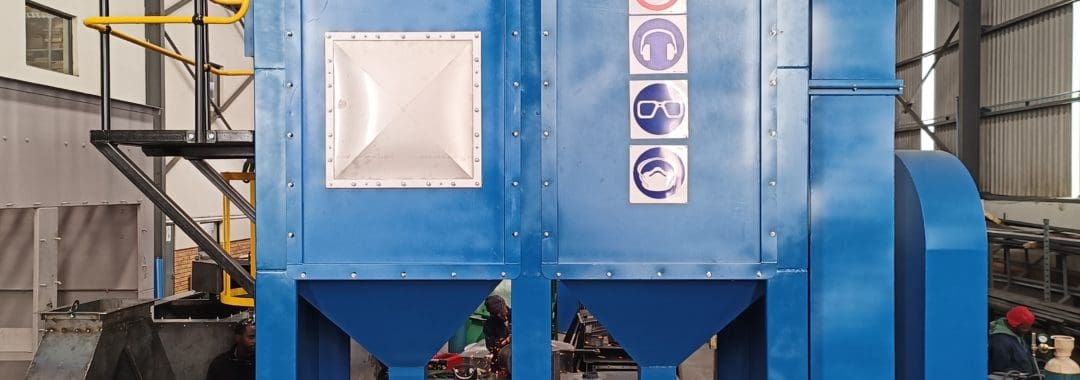
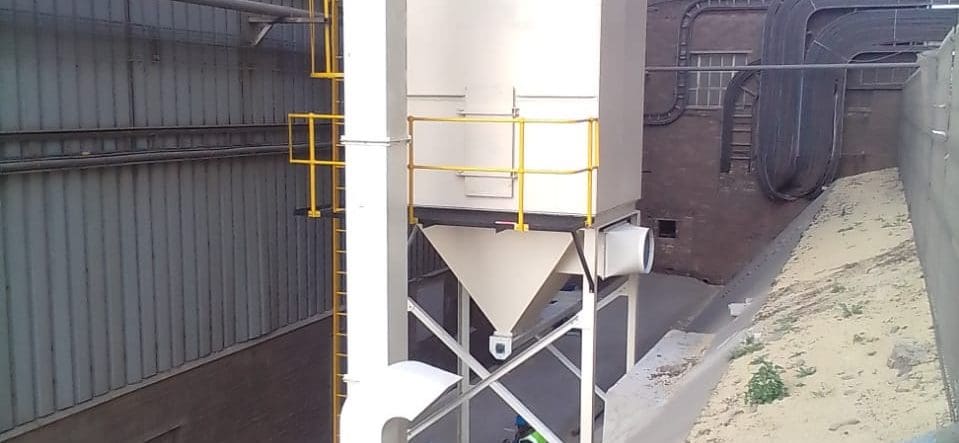
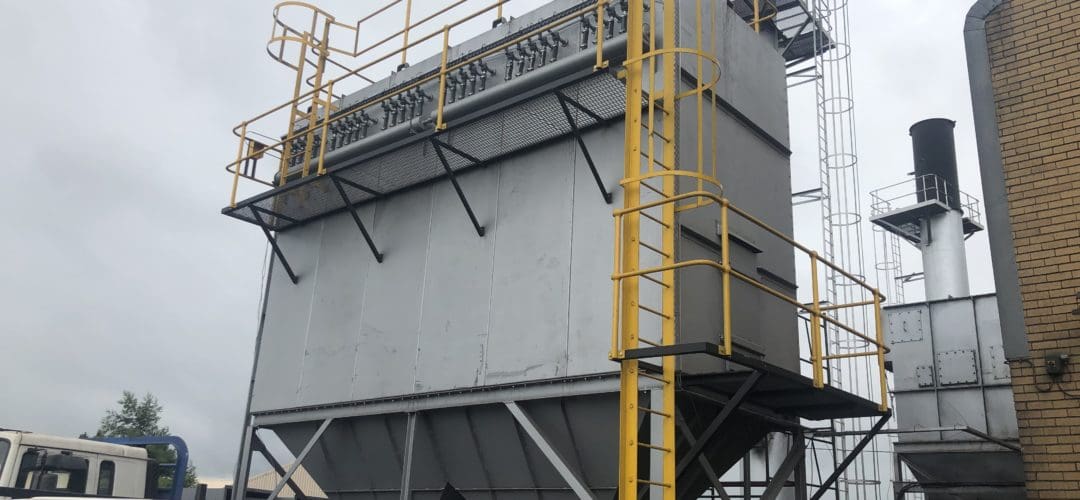
A sugar plant in Zambia needed anti-static membrane bags, an explosion panel and two driven rotary valves. A soya plant in Mpumalanga needed 164 m² of filter area with a screw conveyor and rotary valve. A coal and husk boiler needed coated high-temperature bags for gas above 250 °C, with spark attenuation boxes and a full set of pressure, level and temperature sensors.
Getting the sizing right
The key number in baghouse design is the air-to-cloth ratio: how much air passes through each square metre of filter. Run it too high and the bags blind, pressure drop climbs and fan capacity falls. Run it too low and the collector costs more than it needs to. The right ratio depends on the dust. Fine, light dust needs more filter area than coarse, heavy dust.
We also look at inlet design and can velocity, so incoming dust does not sandblast the bottoms of the bags, and at the hopper angle, so dust does not bridge.
Options
- Built-in or upstream cyclone pre-separator for abrasive or heavy dust loads.
- Explosion relief panels and anti-static bags for combustible dust.
- Insulation and trace heating to stay above the dew point.
- Stainless steel construction for food and corrosive duties.
- Spark arrestors ahead of the bags for grinding and hot work.
- Silencers, access platforms, ladders and handrails.
FAQ
How efficient is a baghouse dust collector?
A correctly sized pulse-jet baghouse cleans the air to better than 99%. For very fine dust or tight emission limits we use PTFE membrane bags.
How long do baghouse filter bags last?
Typically two to four years, depending on the dust, temperature, air-to-cloth ratio and how well the pulse system is set up. Bags that fail much sooner usually point to a design or cleaning problem we can fix.
How much compressed air does a baghouse use?
It depends on the number of bags and how often they pulse. Pulse-jet cleaning only fires on demand or on a timed cycle, so consumption is modest. We specify the air supply, receiver and dryer needed for your unit.
What does differential pressure tell me?
It shows the resistance across the bags. A steady reading means the cleaning is working. A climbing reading means the bags are blinding or the pulse system has a fault. A sudden drop usually means a torn or missing bag.
Can a baghouse handle hot gas?
Yes. With aramid, PPS, PTFE or fibreglass bags, baghouses handle gas up to about 250 °C. For hotter gas we add cooling ahead of the collector.
Send us your dust problem
Tell us what you are extracting, roughly how much air, and where the unit will stand. We will come back with a sizing and a quote. A site visit is free in Gauteng.